codegraph extension
The codegraph extension embeds the @colbymchenry/codegraph library in-process (no MCP server, no daemon). It gives the agent transparent semantic code search over the current project and over dependency sources. Each git worktree gets its own index, so results always reflect the branch being edited.
Internals: the runtime patch, the full index lifecycle, root resolution, labels, and the module map.
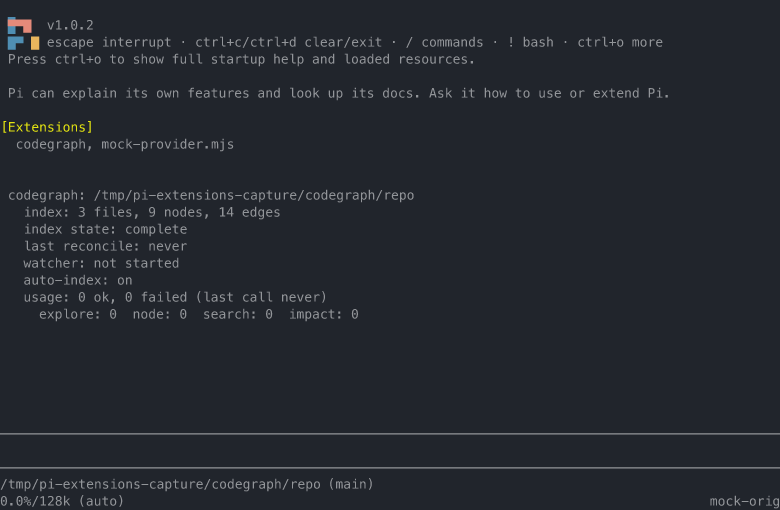
Screenshot
The bare /codegraph command over a small fixture repo: the root with its index counts, index state, last reconcile, watcher, auto-index, and per-tool usage.
Tools
| Tool | Purpose |
|---|---|
codegraph_search | Quick symbol search by name. Locations only, no code. |
codegraph_impact | Show what could break if a symbol changes, by depth. The prompt note tells the agent to call it before a refactor of a symbol. |
codegraph_node | Read a file (line numbers, dependents header) or a symbol (signature, body, top callers and callees). File mode behaves like the built-in read, plus which files depend on it. |
codegraph_explore | Source, call paths, and relationships for an area in one call. The default first tool for "how does X work" questions. The call trail carries the caller and callee information the dedicated tools used to give. |
The caller and callee tools (codegraph_callers, codegraph_callees) keep their definitions in the handlers module but are not registered (issue #72): codegraph_explore carries their information in its call trail, and the measurement showed the agent answered those jobs with explore. Re-adding either is one line in the TOOL map, a registration change, not a re-implementation.
Every tool takes an optional projectRoot argument. Without it, the call is served from the worktree the call was made in, resolved automatically. codegraph_search also takes kind (a single kind string or an array).
Per-worktree indexes
Every git worktree gets its own index under <worktree>/.codegraph/:
- Borrowed indexes are never served. If the nearest initialized index lives in another worktree, it is not used; the worktree gets its own index instead.
- Seeding. A new worktree copies the index database from a sibling worktree of the same repository (shared common git dir) and reconciles, instead of building from scratch.
- Prewarm. The first agent turn of a session starts a background build for a worktree that has no index. The first
codegraph_*call waits for that build and is served from it, so the build is never paid twice. A background failure never becomes a tool result. - Freshness. The index is reconciled on first use per session, then the file watcher keeps it current. If watching is disabled, the index is reconciled before every query.
- Staleness gate at emission. Sliced source is checked against its indexed record before it is emitted. A drifted file never emits a slice; a small one serves its full current source instead.
The full lifecycle (prewarm internals, watcher degradation, cross-process build locks, the staleness gate) is on the internals page.
Querying dependency sources (projectRoot)
A projectRoot argument serves the call from a dependency source: the source tree of one version of one dependency, typically in the opensrc cache home. The argument takes the path rule (absolute, ~, or relative to the working directory). Rules:
- Trusted roots gate the build. An index for a named root is built only at or under a trusted root: the opensrc cache home (
OPENSRC_HOME, else~/.opensrc, when it exists), theCODEGRAPH_PI_TRUSTED_ROOTSentries, and the roots/codegraph addstores for the session. A build outside every trusted root is refused with a reason that names the command to run. An index that already exists is served wherever it lives. - Labels. Every result from a named root is prefaced with one line:
Project: <name> @<version> - <absolute path>. The label comes from the opensrc cache manifest. It makes a wrong version visible and gives the agent the path to hand to its next read or grep. - Snapping. A directory inside a cache entry serves that entry's tree, so a sub-directory of a dependency works.
- On demand, always finished. A named root is built on demand, and a call that starts the build waits for it and always finishes: no timeout, no "retry later". While the build runs, its progress (the file counts the adapter reports) streams to the caller as tool updates, so the wait is visible and bounded instead of a silent hang. Later calls pay only the reconcile. The root is reconciled before every query, cached per root for the session, and never prewarmed, seeded, or watched.
- Missing sources. A named directory that does not exist fails with
no such directory (<abs>)plus a hint that names theopensrc fetchfor the dependency. The extension never fetches on the agent's behalf.
Real example with opensrc
Say the agent edits code that calls into the herdr library, and its source is in the opensrc cache. The agent finds the cache directory and queries it:
$ opensrc path herdr
/home/seriousjul/.opensrc/repos/github.com/ogulcancelik/herdr/0.0.0
Then it passes that directory as projectRoot:
codegraph_explore(
  query: "worktree create",
  projectRoot: "/home/seriousjul/.opensrc/repos/github.com/ogulcancelik/herdr/0.0.0"
)
The first call builds the index for that cache entry (a full build, since named roots are not prewarmed); later calls in the session hit the cache. Every result is labeled, so the agent never confuses herdr symbols with symbols of the project it edits:
Project: herdr @0.0.0 - /home/seriousjul/.opensrc/repos/github.com/ogulcancelik/herdr/0.0.0
...symbols, call paths, and source slices from the dependency...
One projectRoot serves one call. To read the dependency's text that is not a symbol (comments, config, log strings), the agent greps the same path:
rg "pattern" $(opensrc path herdr)Recommended global AGENTS.md section
The system prompt note (below) teaches the agent about codegraph inside each session. For dependency sources, add this section to your global ~/AGENTS.md so every agent of every project learns the pattern, including the grep form the prompt note does not cover:
## Source Code Reference

Source code for dependencies is cached at `~/.opensrc/`. A dependency is
indexed on first use: the first codegraph call to its cache directory builds
the index inline, may wait a few seconds, and reports progress as it builds.
Later calls pay only the reconcile. To explore a dependency, use the
codegraph tools with `projectRoot` set to its cache directory
(`opensrc path <package>`). Use `codegraph_explore` for symbol source and
call paths, `codegraph_search` for symbol names, and `codegraph_node` to
read a file. Use grep for text that is not a symbol (comments, config
values, log strings):

```bash
rg "pattern" $(opensrc path <package>)
```
The block only pays off when the opensrc cache exists, because the prompt note's dependency line appears only when at least one trusted root exists on disk.
System prompt note
Every agent turn appends one note to the system prompt: a first line that states the index state (ready, building, or none), then fixed policy lines that say which tool fits which job. It is the only codegraph steering text in the prompt, so it is the single place to change policy. The impact line targets the trigger the agent actually meets (a refactor of a symbol, not every change), and the dependency-source line carries the first-use promise (the first call to a dependency builds its index and may wait, and the build reports progress). A dependency-source line joins the block only when at least one trusted root exists on disk. The note carries no per-dependency state, so the system prompt stays stable turn to turn and the provider cache stays warm. The note appears only when at least one codegraph_* tool is active, a call can actually be served from the working directory, and the runtime stack passes its preflight check.
/codegraph command
| Verb | Effect |
|---|---|
/codegraph | Index status for the current directory, the named roots this session opened, and the trusted roots with their origin. |
/codegraph status [path] | Index status of the named root the path names, or the session root without a path. |
/codegraph init [path] | Force a full rebuild of the index for the given root (trust-gated), or the session root. |
/codegraph seed [path] | Re-seed the session index from a sibling worktree, or seed the named root a path names. Then reconcile. |
/codegraph uninit [path] | Remove the index for the given root (or the session root), with its usage log. Asks for confirmation. |
/codegraph add <path> | Trust a directory for named-root builds for the rest of the session. |
/codegraph auto on|off | Toggle automatic index creation for the session. |
Status shows local usage from <worktree>/.codegraph/usage.jsonl: per-tool counts, successful and failed calls, time since the last call, and the reason of the newest failure. The log is append-only, never leaves the machine, and is removed with the index by /codegraph uninit. Delete the file to start the counts over.
Environment variables
| Variable | Effect |
|---|---|
CODEGRAPH_PI_AUTO_INDEX | 0/false/off disables automatic index creation (tools return the fallback line until an index exists). |
CODEGRAPH_PI_PREWARM | 0 disables the first-turn background build. Existing indexes are never prewarmed. |
CODEGRAPH_PI_SEEDING | 0/false/off disables seeding from sibling worktrees (first build is from scratch). |
CODEGRAPH_NO_WATCH | 1 disables the file watcher (reconcile before every query instead). |
CODEGRAPH_PI_SQLITE_SHIM | Set to bun to force the shim's bun:sqlite path (used by the bun-only test). |
CODEGRAPH_PI_TRUSTED_ROOTS | PATH-style list of trusted roots for named-root builds. Entries that do not exist are ignored. |
OPENSRC_HOME | The dependency cache home. When it exists it is a trusted root and the source of project labels and fetch hints. When set but missing, the extension behaves as if opensrc were absent. |
CODEGRAPH_NO_FAST_INIT | Set to 1 automatically on the bun runtime unless the user set it (bun's SQLite engine rejects the fast-init journal-mode change). |
CODEGRAPH_TELEMETRY | Set to 0 by this extension unless already set. |
CODEGRAPH_NO_UPDATE_CHECK | Set to 1 by this extension unless already set. |
Failure contract
Every tool failure ends with the same line, which tells the model to fall back to the built-in tools:
codegraph is unavailable (<reason>). Use the built-in read and grep tools instead.The reason is recorded in the worktree's usage log, so /codegraph status shows it after the tool result has scrolled away. The extension never turns a codegraph failure into a session error.