model-router extension
Recovers a pi session from a provider usage-limit (quota) halt without the user re-running the prompt. When the active model's provider reports a terminal usage-limit error and pi's own retries give up, the router runs the configured strategies in order: switch to a fallback model, or wait for the quota window to reset. When the session runs again, the halted turn resumes through one synthetic user message. The router switches back to the original model once the quota recovers and the session is idle.
Works from any session. It reads the OpenAI ChatGPT plan's quota windows through the Quota source module (extensions/quota/source.ts, issue #28), which owns the ChatGPT token refresh (ADR 0005).
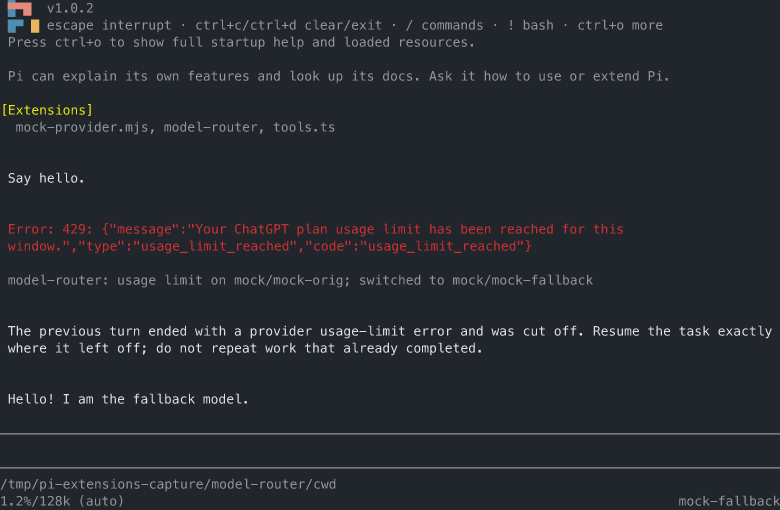
Screenshot
A usage-limit halt and the switch recovery in one turn: the 429, the router notification, the resume message, and the fallback model's answer. The status bar has moved to the fallback model.
Behavior
- Quota halt detection. After a turn settles with an error, the router classifies the assistant message's error text. Only terminal usage-limit shapes start a Recovery; transient throttles and overloads stay with pi's built-in retry.
- Strategies, in Precedence order.
switchmoves the session to the first usable fallback model.waitarms a timer for the binding reset (the latest reset among the exhausted windows) and resumes when it confirms the quota is back. - Bound. At most three full strategy cycles per failed prompt, then one error notification and a clean stop. A fallback that fails with its own usage limit advances the chain.
- Switch-back. While on a fallback the router set, the router switches back to the original model once the quota recovers and the session is idle.
- Cancel. User input cancels a pending wait. A manual model change cancels both the pending wait and the pending switch-back.
- Restart. A pending recovery is persisted in the session and re-armed on the next start, so waiting does not depend on the terminal staying open.
- Provider scope. The wait strategy and the switch-back only apply to the
openai-codex(ChatGPT plan) provider, because that is what the Quota source reads; for any other provider only switch applies.
Settings
The modelRouter section of settings.json. Project <cwd>/.pi/settings.json overrides global ~/.pi/agent/settings.json, key by key.
| Key | Type | Default | Meaning |
|---|---|---|---|
enabled | boolean | true | Turn the router on or off. |
precedence | ("switch" | "wait")[] | ["switch","wait"] | Strategy order on a halt. |
fallbacks | "provider/model-id"[] | [] | Ordered "provider/model-id" entries the switch strategy tries. |
maxWaitMinutes | number greater than 0 | 360 | Only wait when the binding reset is within this many minutes. |
{
  "modelRouter": {
    "precedence": ["switch", "wait"],
    "fallbacks": ["anthropic/claude-sonnet-4-5", "google/gemini-3.5-flash"],
    "maxWaitMinutes": 360
  }
}
A malformed value falls back to its default and is reported with one startup notification. A fallback entry whose model is missing or has no configured auth is skipped; if none are usable the router moves to the next strategy.
How it works
- Resume. pi has no re-run-the-failed-turn API, so the router resumes the halted turn with one fixed user message (ADR 0006). That message is the only visible trace of a recovery.
- Token refresh. The Quota source refreshes an expired ChatGPT access token before reading, retries once after a 401, and otherwise reports the read failure. The router treats an unreadable quota as "wait not viable".
- Seam. The decision logic lives in
router.ts, which is engine-free and fully tested with injected quota reads, clock, timers, model lookups, and an action sink.index.tsis the thin pi wiring.
Notifications
Exactly four recovery-transition points, plus one per skipped-fallback summary:
- Wait starts, with the ETA.
- Switch to a fallback.
- Switch back to the original.
- Recovery gave up (error level).
Real example: a fallback chain walk
Observed in a live session on 2026-09-14. The user typed test on qwen-token-plan-individual/qwen3.8-max while the token plan was exhausted. The error body carries insufficient_quota, which the classifier matches:
13:06:38  ASSIST qwen3.8-max  stop=error
          429: {"message":"Your token-plan 1-week quota has been
          exhausted. The quota will reset at 09-19 15:43:00 UTC.",
          "type":"insufficient_quota","code":"insufficient_quota"}
          -> router switched to qwen3.8-flash
13:07:15  ASSIST qwen3.8-flash  stop=error (same 429)
          -> persisted recovery: {"phase":"on-fallback",
             "original":"qwen-token-plan-individual/qwen3.8-max",
             "chainPos":2,
             "fallbackInUse":"qwen-token-plan-individual/qwen3.8-flash",
             "cycles":1}
          -> router sent the Recovery message; flash halted on it
          -> chain advanced: chainPos 3,
             fallbackInUse llama.cpp/unsloth/qwen3.8-27b, cycles 2
          -> router sent the Recovery message on the local model
13:07:24  ASSIST llama.cpp (unsloth/qwen3.8-27b) ran the resumed turn
The wait strategy did not run: it applies only to openai-codex, so this recovery was a pure switch walk until the local model took over. The model-router-pending session entries above are also what re-arm the recovery if the session restarts mid-walk.
Out of scope
Transient throttles and overloads (pi's own retry), context overflow, and non-ChatGPT quota plans (the Quota source covers the ChatGPT plan in v1).