context-cap extension
Caps the effective context window for a pi session, so auto-compaction fires early and prompts stay small:
bash
pi --context-window 32000
# or
PI_CONTEXT_WINDOW=32000 pi
The flag wins over the env var. The value is a token count, not a percentage.
Screenshot
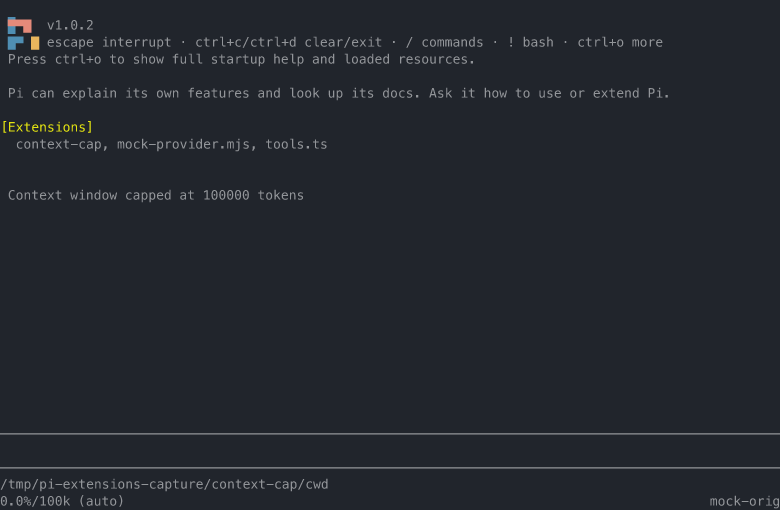
Startup with --context-window 100000: the one-time notice, and the footer showing the capped window as the model's budget.
Behavior
- The cap is a ceiling: the effective window is the smaller of the cap and the model's resolved window (after
models.jsonmodelOverrides). It never grows a window. - For a live-catalog provider (llama.cpp), whose model list pi re-fetches from the server, the cap is not re-registered: a static capped list would freeze the live window in place. There the cap is enforced on the session's model at every boundary the window is consumed (selection, run start, turn start, turn end, run settle), so a mid-session model re-apply (the llama refresh heal) cannot widen it past the cap.
- It is session-wide: the initial model, model switches, scoped-model cycling, and resume all operate under the cap. The
/modelpicker and the footer context percentage show the capped window. - Compaction timing, overflow detection, and the footer percentage all use the capped window, because pi reads one field:
model.contextWindow. - The resolved cap is published to a shared record, so the llama refresh compare clamps both sides of its compare to it: a drift the cap hides (the live window stays above the cap) moves nothing and says nothing.
- A one-time notice confirms the active cap at startup.
Rejection
pi reports an error and runs uncapped when:
- the value is not a positive integer, or
- the cap is at or below
compaction.reserveTokens(default 16384). A cap that small would compact every turn.
How it works
On session start the extension re-registers each provider that has a model above the cap with capped copies of its full model list, clamps the model objects the session already resolved in place, and publishes the resolved cap to the shared record in extensions/shared/context-window-cap.ts (the llama refresh compare reads it). See ADR 0004.
Known edges
- Providers whose model list pi refreshes from the network after startup (for example a local llama.cpp server) keep their live list: the cap skips their re-registration and clamps the session's model at every boundary the window is consumed.
- A model with no configured auth is left untouched.