compress extension
Compresses finished turns out of outgoing LLM requests without touching the session file. A turn that falls out of the keep window is replaced in every outgoing request by one short synthetic user message carrying a compressed form of the turn. The full original messages stay in the session file, and each compressed span is persisted as a compress-span custom session entry (ADR 0015).
Compression is opt-in: the extension does nothing until a compression model is set with /compression-model.
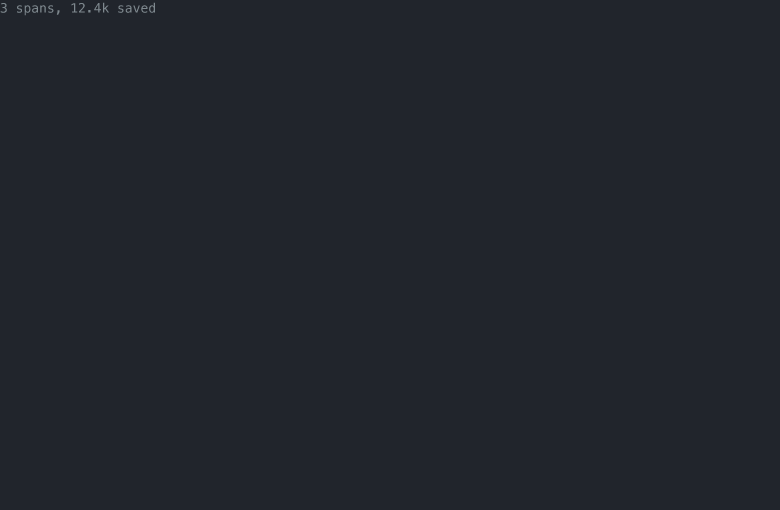
Screenshot
The status bar line the extension adds once spans exist: the span count and the tokens saved, in dim text.
Behavior
- Keep window. The last
keepTurnsfinished turns, plus the turn in progress, always go out raw. Every older finished turn is a span. - Prewarm. After each turn ends, the extension compresses every uncached span that is at least
minSpanTokenstokens, one call at a time in the background. Small spans never earn a call. - The form. One call to the compression model: the turn serialized with pi's role labels, every tool result cut to head + tail (2000 characters total, so a failure's error line at the tail survives), and a prompt that keeps user instructions verbatim and quotes error strings exactly as shown. The form is capped at
spanCapTokens; the request's token budget is the cap plus a 1024-token thinking reserve, so a thinking model can reason before writing the note, and the form is trimmed back to the cap afterwards. - The swap. The next outgoing request replaces each cached span with one user message: a fixed lossy-view frame, then the form. The extension rewrites a request only when it can reconcile pi's exact message list from the session entries: every message must match in order, and only failed assistant messages (the ones pi removes from its state while retrying a call) may be absent. Anything else it cannot reproduce goes out untouched, and the check re-runs on every request.
- Failure. A failed compression call leaves the span raw and retries after the next turn, with one warning per span. A span that fails three calls in a row stops earning calls and stays raw for the session; changing the compression model resets the counter. A span whose serialized input does not fit the compression model's context window (input plus the cap plus a 1k-token margin) never earns a call.
- Startup retry. If the configured model is not in the registry at session start, compression starts off and the resolution re-runs after each turn. A local provider registers its models on demand, so a model that is still loading or asleep at start resolves later in the session. When it resolves, compression turns on from that turn and the failure counters restart.
- Restart. Spans already have their persisted form, so no compression is re-run after a restart.
- Usage. Each compression call is a normal LLM event: its usage is in the span entry and counts in the Usage report under the compression model.
Command
/compression-model [off | provider/model-id]
- No args: shows the current model, span count, and tokens saved, then opens a model picker (an
offentry disables). off: disables compression and persists it.provider/model-id: sets the model directly. A model that is missing or has no configured auth is rejected.
The choice persists to the project .pi/settings.json when that file exists, else to the global settings file.
Settings
The compress section of settings.json. Project <cwd>/.pi/settings.json overrides global, key by key.
| Key | Type | Default | Meaning |
|---|---|---|---|
enabled | boolean | true | Turn the extension on or off. |
model | "provider/model-id" or null | null | The compression model. null: compression off. |
keepTurns | number ≥ 0 | 2 | Recent finished turns that always go out raw. |
spanCapTokens | number > 0 | 500 | Cap for one compressed form, in tokens. |
minSpanTokens | number > 0 | 1000 | A span smaller than this never earns a compression call. |
Example:
{
  "compress": {
    "model": "anthropic/claude-haiku",
    "keepTurns": 2,
    "spanCapTokens": 500,
    "minSpanTokens": 1000
  }
}
A malformed value falls back to its default and is reported with one startup notification.
Status
While spans are compressed, the status line shows the span count and the tokens saved, for example compress: 3 spans, 12.4k saved.
How it works
- Seam. The decision logic lives in
core.ts, which is engine-free and fully tested with an injected token estimator and serializer: given the turns and the cache, it produces the outgoing message list and the compression jobs.serializer.tsturns one turn into the compression model's input.settings.tsreads and writes the settings section.runner.tsruns one job through pi's model registry as a fresh conversation (new session ID, no cache retention).index.tsis the thin pi wiring.
Out of scope
Recompressing a span when the compression model changes (the first form stays), mid-conversation compaction of the keep window, and per-tool output shrinking.